Slingsby T.21 Sedbergh TX.1
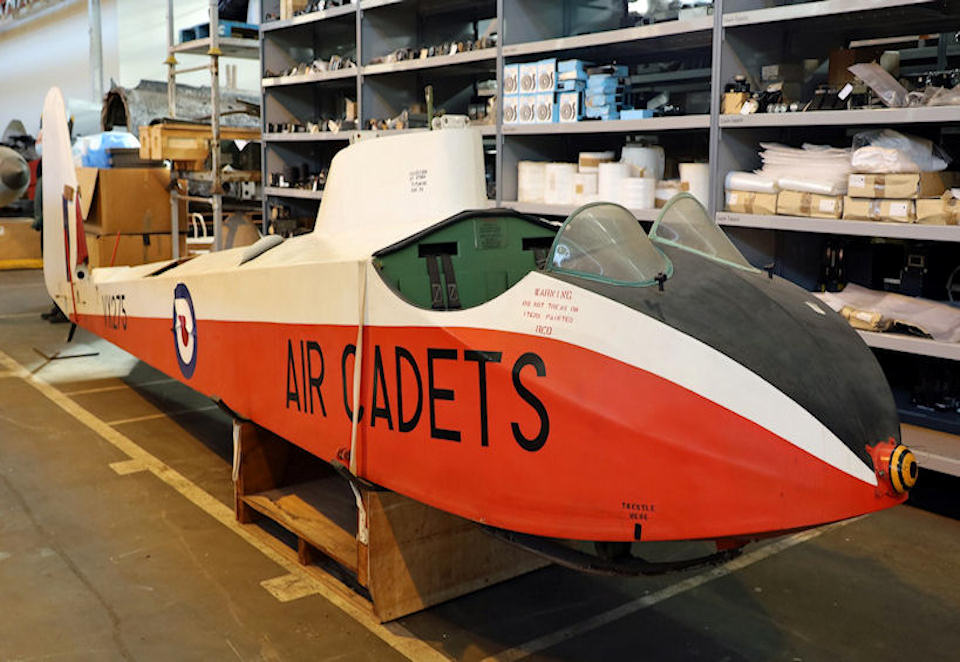
Registration: VX275
Country of origin: UK
Built: Kirkbymoorside, Yorkshire, 1948
Manufacturer: Slingsby
Constructor's Number: 539
Engine: Glider
Type: Dual seat training glider
Note: The Sedbergh two seat side-by-side glider, affectionately know as 'The Barge', was used by 621 Volunteer Gliding Squadron and by Air Cadets flying at the gliding school that was based here at Weston airfield.
Details: The original Sedbergh (or ‘Barge’ as it was commonly and affectionately known by its pilots) was built by Slingsby at its factory in Kirkbymoorside, Yorkshire for use by the RAF Air Training Corps (now the RAF Air Cadets) and first flown in1944. It was named ‘Sedbergh’ after the nearby public school and the standard production model first flew in December 1947. However, the glider was initially rejected by the Air Ministry and it was not until the London Gliding Club bought two and found them extremely useful that they changed their minds and ordered the type, the first of which entered service in 1950. Many cadets earned their wings on the Sedbergh and the Slingsby T31 Tandem Tutor (named by the ATC, the Cadet Mark III, alias ‘The Brick’). After long and successful service life they were retired in 1983 and replaced by more modern fibreglass gliders.
621 Gliding School, or ‘Volunteer Gliding Squadron’ as it was latterly known, was based here on Weston Airport and operated two Sedberghs and three Cadet Mk IIIs from 1950 to 1983. Many cadets were trained here, either on weekend courses or week-long courses in the summer. Many of these cadets went on to serve in the armed forces and some became professional commercial pilots. The Air Cadet organisation still provides an important stepping stone for many young people, though regrettably not on the scale it used to. 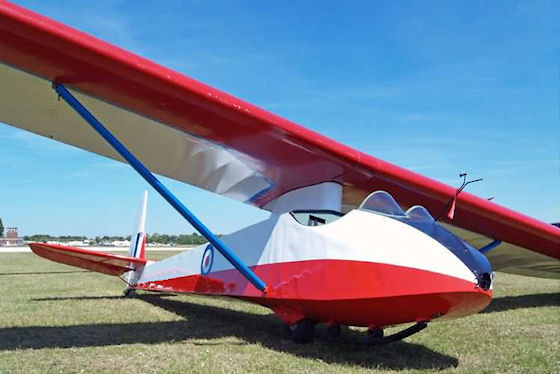 VX275 was built as a civil glider to T21A standard and, in January1948, was purchased by a consortium which was headed by Mrs F D Heppell of Maidenhead. It comprised units of the Berkshire Wing of the ATC and the funding was augmented by proceeds from a fete at Maidenhead in 1946. The purchase price was £750 and it was the first T21 to join the ATC. It was presented to the Air Ministry at White Waltham airfield by H A Benyon, the Lord Lieutenant of Berkshire, on 27th March 1948 and was christened ‘Venture’ by Mrs Heppell. After the ceremony the first flight took place with F/L J A West, the C/O of 123 Gliding School, at the controls with Mr W F Herbert (Chairman of the Berkshire ATC Committee) as his passenger.
During its life VX275 was updated to T21B standard and served with Nos 123 GS (which became 623 GS), 613 GS and 612 GS before being utilised as a ground instructional airframe at RAF St Athan registered 8884M. After retirement in 1983 the vintage glider was allocated to the RAF Museum and stored at Cardington, Wyton and Cosford and finally RAF Stafford.
In 2022 the RAF Museum decided to reduce its vast collection of airframes and artifacts it had in storage and VX275 was made open for bids ‘for museums/registered charity use’. The Helicopter Museum was successful in its bid and a three-year restoration of the fragile fabric covering and other components began. The prime mover in the recovery and restoration of the airframe was the Air Cadet Historic Flight based at the Bristol and Gloucester Gliding Club’s airfield at Nympsfield, Gloucestershire. Our thanks go to the members of the ACHF who surveyed and transported 275 around the South of England and especially to one of their Trustees, Al Stacey, who restored it to first-class display standard and returned it to the museum - all at little cost to us.
Performance:
Max Speed: 92kts (170km/h) Stalling Speed: 28kts (52km/h)
Empty Weight: 589lb (267kg) Max Weight: 1047lb (475kg)
Minimum Sink Speed: 33.5kt (62km/h) Best Glide Ratio: 1 in 21 at 37kts (62km/h)